


By the time the Air Jordan reached its fifth model in 1990, the brand was already an established force in sports footwear. Luxury basketball sneakers had become the ultimate status symbol—the one thing every kid begged their parents for (a sentiment that remains unchanged today). It’s easy to forget that back then, these silhouettes cost over $100—well over $200 in today’s value—which was the primary reason most kids were denied the chance to flex in a brand-new pair of Jordans. While other sneakers were becoming obsolete or failing to innovate, Air Jordan maintained its momentum with a new icon.
Following the massive success of the AJ3 and AJ4 was no easy task. Once again, we have Tinker Hatfield to thank. His new design, inspired by the aggressive elements of a fighter plane, made the market even "thirstier," continuing the powerful evolution of the Jordan line.
The 1990 Invasion
The Air Jordan 5 was the first model to kick off a new decade, hitting shelves in 1990 with a retail price of $125. Another masterpiece by Tinker Hatfield, it was famously inspired by WWII Mustang fighter planes, most notably featuring the "shark tooth" shapes on the midsole.
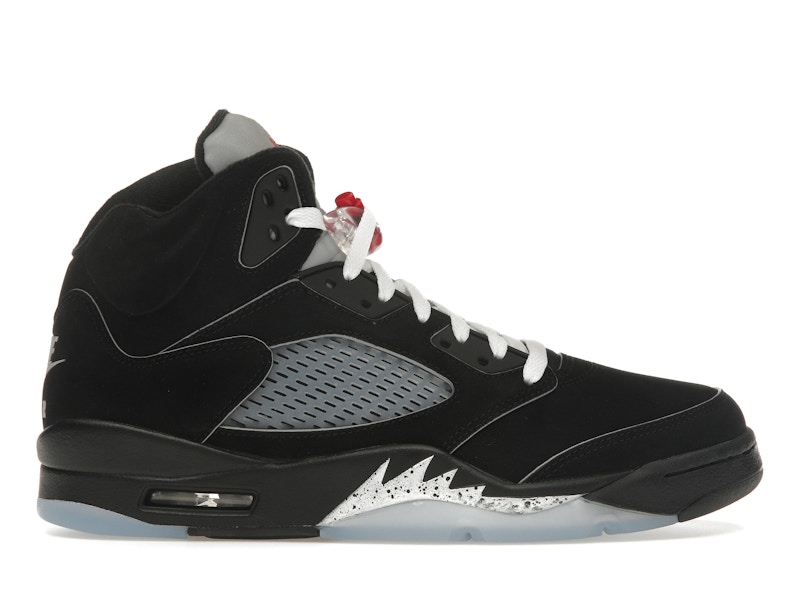
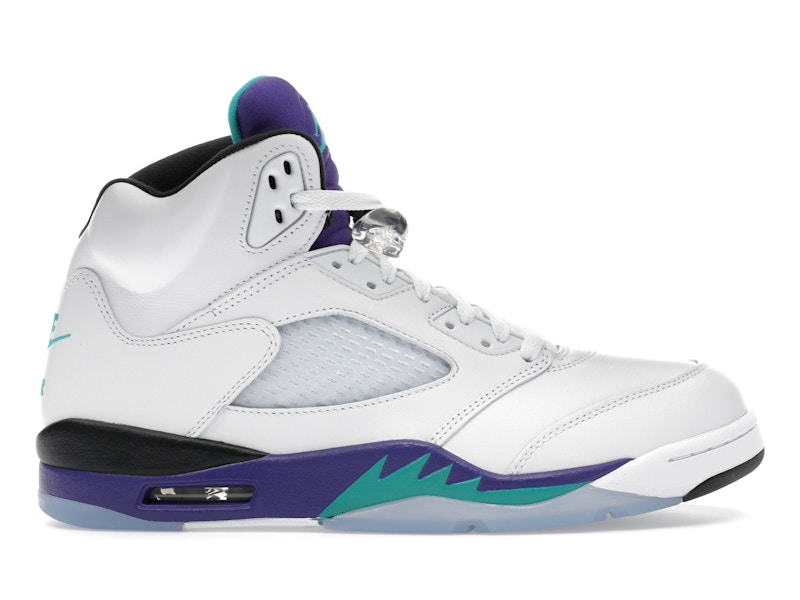
Unlike today’s market where shoes drop in endless colorways, the AJ5 originally launched in just four versions: the White/Black/Fire Red (featuring the 3M Reflective tongue), the White/Fire Red/Black, the Black/Metallic Silver, and the stunningly unique "Grape."
Details in the Stitching
While almost every AJ5 today features a stitched "23" on the heel, originally, that detail only appeared on one of the four OG colorways: the Fire Red. For the other versions, only Michael’s personal player-exclusive (PE) pairs featured the number. It wasn't until the 2000 release of the "Laney" (inspired by Jordan’s high school) and the White/Metallic that the "23" embroidery became a standard feature for most retros.
Innovation: From 3M to Icy Soles
Tinker was a pioneer in material science. He took 3M reflective material—traditionally used on running shoes to increase nighttime visibility—and applied it to the tongue of the AJ5. His goal was to make the shoe "pop" and grab attention every time Michael flew through the air or was captured by a photographer's flash.
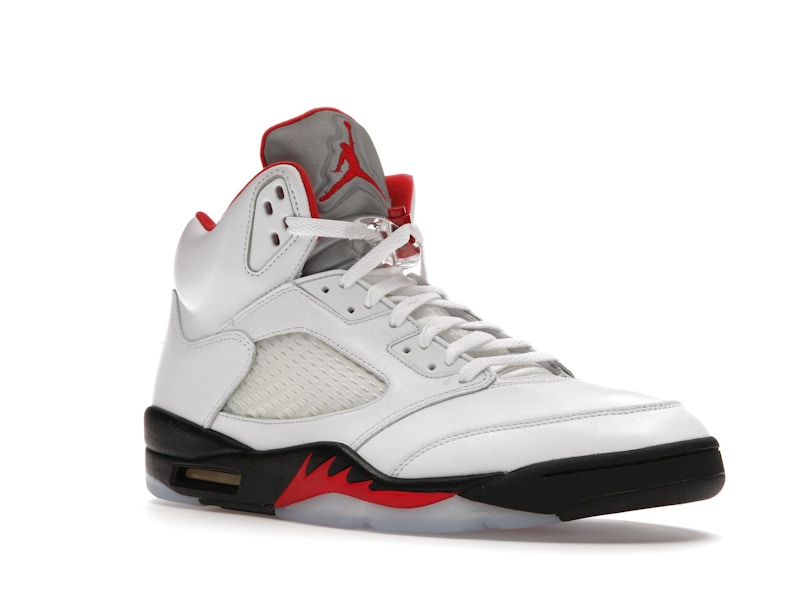
The AJ5 also introduced the translucent "Icy" outsole. Today, clear outsoles are common, but in 1990, seeing a Jumpman through the bottom of a shoe was mind-blowing. Alongside the 3M tongue and icy soles, the AJ5 was the first model equipped with a "Lace Lock," a functional piece of hardware that would return on the AJ6.
Ergonomics and Records
The AJ5 featured an asymmetrical collar—an ergonomic design where the outside of the shoe is lower than the inside, providing better support for the ankle during high-intensity movements.
While the Air Jordan 6 holds the honor of being the shoe MJ wore for his first championship, the AJ5 came remarkably close. In these shoes, Michael led the Bulls to the Eastern Conference Finals before being relentlessly brought down by Detroit’s "Bad Boys." Despite that postseason exit, the AJ5 holds a special achievement: on March 28, 1990, in a victory over Cleveland, MJ scored a career-high 69 points. He also secured his fourth consecutive scoring title during the 1989/90 season in the 5s.
The Remastered Era
The Air Jordan 5 was among the first models chosen for the "Remastered" initiative (aimed at matching OG quality and craftsmanship). The 2015 "White/Metallic" release was a fan favorite, but 2020 brought something even more special. During the legendary "The Last Dance" documentary series, Jordan Brand launched the AJ5 "Fire Red" OG.
This 2020 edition was a dedicated effort to mirror the 1990 original, featuring the Nike Air logo on the heel and genuine leather construction (shifting away from the synthetic materials used in the 1999 version). Interestingly, the "Air Jordan" tag on the inside of the tongue is stitched upside down—a detail we also see on the AJ4. While the 1999 retro had it stitched "normally," the upside-down tag is considered the true tribute to the original vision.
Whether you are a collector of the original 1990 pairs or a fan of the latest "Remastered" editions, the Air Jordan 5 remains a masterpiece of design—a shoe that truly turned the basketball court into a battlefield.
← Air Jordan 4 History | Air Jordan 6 History →
Ready for your own game? Browse our basketball shoes (not sure which pair? read how to choose basketball shoes) – and if this era is your era, there are NBA jerseys too.